

 Tiếng Việt
 中文 (中国)
After a short period of impressive growth, Vietnam’s fresh coconut exports are beginning to show signs of instability. Currently, the price of fresh coconuts in the Mekong Delta ranges from 30,000 to 40,000 VND per dozen (12 fruits), equivalent to 5,000-6,000 VND per kilogram for export-grade produce the lowest level since Vietnam officially began exporting coconuts to China in October 2024.
According to Truong Tan Tuan, Director of Năng Lượng Coconut Company (Vinh Long Province), the market is currently in a period of oversupply due to the rainy season, when productivity rises while demand falls.However, Cao Ba Dang Khoa, Vice Chairman and Secretary General of the Vietnam Coconut Association, said the sharp price drop is not merely seasonal but reflects a “market shock.”
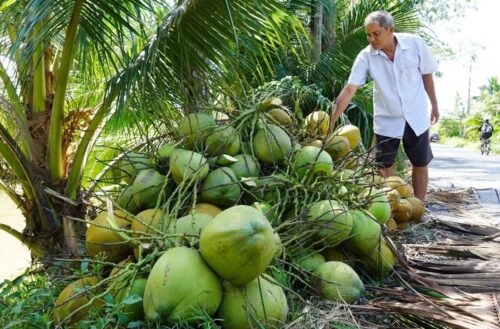
He explained that the fresh coconut industry has grown too fast, resulting in many exporters purchasing and shipping coconuts without proper quality control. “Some containers sent to China were like a ‘hotpot mix’ mixed varieties, sizes, and flavors. As a result, buyers rejected the shipments, forcing companies to bring them back and sell cheaply in the domestic market,” Mr. Khoa said.
During recent discussions with the Pingxiang Fruit Association in China, importers also complained about inconsistent quality from Vietnamese coconuts. “Each purchase brings a different quality. It’s hard to maintain trust with consumers,” Mr. Khoa quoted Chinese partners as saying.
In fact, Vietnam currently has 16 varieties of drinking coconuts, and many farms grow multiple types together. Farmers usually insist that traders buy the entire crop, making sorting and quality control for export extremely difficult.
Therefore, to ensure sustainable development, the industry needs planned production zones, strict quality management, and transparent farming practices. Growers must also record farming activities, something few currently do. For the U.S. market, Mr. Khoa said retail prices in Chicago supermarkets reach US$4.39 per fruit (≈120,000 VND), showing huge potential. However, markets like the U.S. and EU require strict compliance with sustainability, social responsibility, and fair trade standards.
Observers have drawn parallels between the coconut industry’s current trajectory and the earlier “boom-and-bust” cycles of dragon fruit and durian. Dang Phuc Nguyen, Secretary General of the Vietnam Fruit and Vegetable Association, recalled that dragon fruit exports once exceeded US$1 billion annually, but have since dropped to about US$500 million, as competitiveness declined.
Meanwhile, durian, which became a major export success in early 2024, suffered a major setback when China tightened cadmium and auramine residue standards, slashing exports by up to 80%.“Durian is a difficult crop to grow. China has tried cultivating it on Hainan Island but failed that’s our advantage. Yet if Vietnam doesn’t improve quality and production processes, that advantage will soon disappear,” Mr. Nguyen warned.The recent developments underscore one clear message: controlling quality and improving competitiveness through innovation and transparency are vital for both Vietnamese farmers and exporters to sustain their global market presence.