

 Tiếng Việt
 中文 (中国)
Vietnam’s fruit and vegetable exports to the European Union (EU) recorded the strongest growth ever in the first nine months of the year, rising by nearly 52% compared with the same period last year and marking the highest level on record. According to data from Vietnam Customs, as of the end of September, Vietnam’s fruit and vegetable exports to the EU reached approximately USD 269 million, up 51.7% year-on-year. With this growth momentum, industry authorities estimate that total exports to the EU for the full year 2025 could exceed USD 350 million and even approach USD 400 million the highest level ever achieved.
The EU is currently one of the fastest-growing markets for Vietnam’s fruit and vegetable sector, contributing significantly to the diversification of export destinations and reducing reliance on traditional markets. This strong growth has been driven primarily by a clear shift in export structure, with processed products and tropical fruits accounting for an increasingly larger share.
Among exported products, passion fruit has emerged as the leading item in the EU market, accounting for around 25% of total export value and recording growth of over 100% compared to the same period last year. Other products such as mango, pineapple, and coconut also posted double- and even triple-digit growth rates, benefiting from their alignment with Europe’s growing demand for green, healthy, and natural food products.
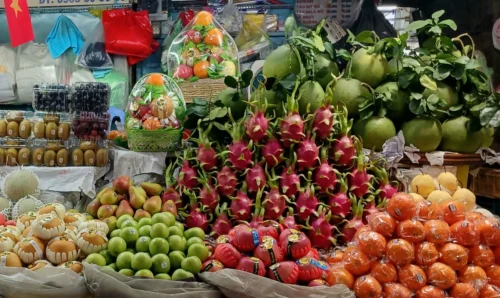
In addition to fresh fruits, processed products have made a notable contribution to export turnover. Certain items such as pistachios, mainly in processed or re-exported forms, have generated significant export value. Meanwhile, durian and dragon fruit are gradually expanding their market share in the EU, although they continue to face intense competition from suppliers in Latin America and Africa.
By destination, the Netherlands remains the largest gateway for Vietnamese fruit and vegetable exports into the EU, accounting for approximately 35-40% of total export value to the bloc. This position is supported by the Netherlands’ role as Europe’s key logistics and distribution hub. Germany and France follow as major markets, with steadily growing demand, particularly for processed products and frozen fruits.
According to Mr. Dang Phuc Nguyen, Secretary General of the Vietnam Fruit and Vegetable Association (Vinafruit), the sharp increase in exports to the EU can be attributed to several factors. First, tariff preferences under the EU–Vietnam Free Trade Agreement (EVFTA) are proving highly effective, giving Vietnamese fruit and vegetable products a price advantage over competitors in the region, such as Thailand, which currently does not have a free trade agreement with the EU.
At the same time, product quality has improved significantly. The number of Vietnamese shipments receiving EU food safety warnings in 2025 has declined by around 50% compared with the same period last year, reflecting strong efforts by businesses to control pesticide residues, enhance traceability, and comply with stringent EU standards.
Notably, the shift toward deeper processing is opening up new growth opportunities for the fruit and vegetable sector. The EU increasingly favors high value-added products such as juices, dried fruits, and frozen fruits, rather than relying solely on fresh produce as in the past. Expanding processing capacity not only helps extend shelf life and reduce logistics risks but also increases export value per unit of product. Although the EU is widely regarded as a highly demanding market, it is emerging as a bright spot in Vietnam’s fruit and vegetable export landscape in 2025. It has recorded the fastest growth among major markets and continues to offer substantial room for expansion in the years ahead.
In response to rising demand, many large processing enterprises are stepping up investment to meet consumption growth in demanding markets such as the EU and the United States. A notable example is WestFood Joint Stock Company, which has recently put into operation the WestFood Hau Giang agricultural processing plant the largest facility in the Mekong Delta. The plant covers an area of 7 hectares, represents an investment of VND 666 billion, and has a designed capacity of 30,000 tons of finished products per year.