

 Tiếng Việt
 中文 (中国)
Flexible governance and coordinated action between the Ministry of Agriculture and Environment and Vietnamese enterprises have enabled fruit and vegetable exports including durian to continue breaking new records, moving towards the target of 8.5 billion USD in 2025.
Durian exports officially surpass the 2024 record
According to the latest fruit and vegetable sector report from the Centre for Agricultural and Environmental Information and Services (Institute of Agriculture and Environment Strategy and Policy, Ministry of Agriculture and Environment), by the end of October 2025, Vietnam’s durian exports had officially surpassed the previous record of 3.2 billion USD set in 2024, an increase of 12.3% year-on-year.Although growth slowed during the first half of the year due to China’s application of testing requirements for Sudan Yellow O and Cadmium, export turnover rebounded strongly from July. In particular, third-quarter exports reached 1.94 billion USD, up 30.3%, owing to the Ministry’s flexible governance and the active involvement of enterprises.
Nguyen Thanh Binh, Chairman of the Vietnam Fruit and Vegetable Association, noted that these results stem from enterprises’ increased adoption of high technology, transparency in traceability, and strict application of planting-area codes and packing-house codes to meet international market requirements.Earlier, to address challenges facing enterprises, Deputy Minister of Agriculture and Environment Hoang Trung issued firm instructions, mobilising relevant departments and agencies to coordinate with Chinese authorities to resolve issues one by one. The overarching goal was to ensure that no durian shipment would be disrupted due to testing or technical procedures.
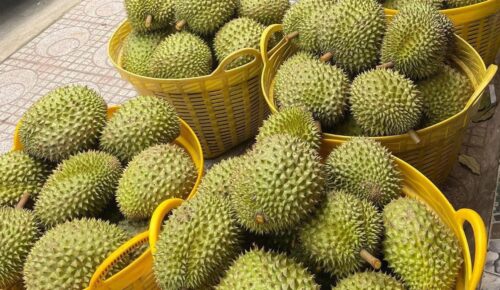
The Department of Quality, Processing and Market Development was tasked with reviewing laboratory capacity and coordinating with the Department of Crop Production and Plant Protection to deploy experts to support localities. Deputy Minister Hoang Trung also directed the mobilisation of all legally qualified units to process backlogged samples, ensuring uninterrupted exports and safeguarding production across roughly 150,000 hectares of durian, with an estimated output exceeding 1.5 million tonnes this year.
The Department of Crop Production and Plant Protection is strengthening technical exchanges with Chinese counterparts, sharing testing data, and continuing to guide localities to be more proactive in sampling and quality control, ensuring production and consumption activities continue smoothly through the end of the durian season. Close coordination between central and local agencies remains the decisive factor in maintaining stable export flows during the end-of-season period. The overall operating principle is rapid, concise, and compliant processing to protect enterprise interests and uphold the reputation of Vietnamese agricultural products in the Chinese market and globally.
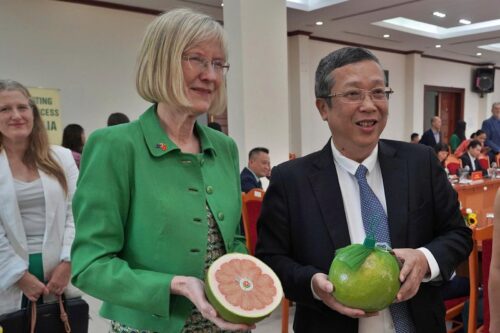
Will fruit and vegetable exports reach 8.5 billion USD in 2025?
Data from the General Department of Customs shows that Vietnam’s fruit and vegetable exports reached 7.09 billion USD in the first 10 months of 2025, up 15% compared with the same period in 2024. China accounts for the largest share at 62.9%, followed by the United States (6.6%) and South Korea (3.9%). Durian, banana and pomelo remain key export items.
According to Dang Phuc Nguyen, Secretary-General of the Vietnam Fruit and Vegetable Association, enterprises have increasingly adopted high-tech solutions and complied with regulations on traceability, planting-area codes and packing-house codes, ensuring conformance with food-safety standards. As a result, Vietnam’s fruit and vegetable exports have expanded to numerous countries, especially durian, dragon fruit, mango, jackfruit, and coconut.Nguyen Dinh Tung, General Director of VinaT&T, emphasised that Vietnam has successfully exported many fruit varieties to demanding markets such as the United States, Australia, Japan, South Korea and Canada, while also meeting China’s stringent technical barriers. Negative feedback rates are very low and continue to decrease each year, demonstrating the sustainable development of Vietnamese agriculture.
With the official entry of Vietnamese pomelo into the Australian market, it is forecast that by the end of 2025, total fruit and vegetable export value will exceed 8 billion USD. Enterprises aim for 10–12% growth in 2026 while expanding more fruit varieties into international markets.With the Ministry of Agriculture and Environment’s continued strategic guidance, Vietnam’s fruit and vegetable sector is capitalising on market-expansion opportunities, enhancing product quality, and strengthening supply-chain linkages from production to consumption. As such, the prospect of reaching 8.5 billion USD in export value in 2025 is entirely feasible, reinforcing Vietnam’s sustainable position on the global agricultural map.
In addition, on 14 November, US President Donald Trump signed an executive order exempting reciprocal tariffs on a range of agricultural and essential food products, including spices, tropical fruits, fruit juice, bananas, oranges and tomatoes. These are goods that the United States either cannot produce domestically or produces in insufficient quantities to meet domestic demand. Therefore, they were removed from the reciprocal tariff list initially announced in April and amended in September.
The new executive order took effect on 13 November and represents a major shift in import-tariff policy, even as President Trump maintains that tariff increases do not cause inflation.According to Dang Phuc Nguyen, this represents a major opportunity for Vietnam’s fruit and vegetable sector. While Vietnam’s total fruit and vegetable exports to the United States amounted to only 360 million USD in 2024, exports in the first nine months of 2025 have already reached 407 million USD. The United States is also the fastest-growing market among the top five, with growth of up to 60%.With the United States’ reciprocal tariff exemption for fruit and vegetable products, Vietnamese goods will enjoy additional competitive advantages in the coming period. Should enterprises continue expanding markets actively, the United States could become a billion-dollar market for Vietnamese fruits and vegetables within the next few years.