

 Tiếng Việt
 中文 (中国)
Vietnam’s exports approached a historic milestone in 2025, with total turnover reaching nearly USD 500 billion. However, behind the impressive headline figures lies growing pressure on domestic enterprises, as export growth continues to be driven primarily by foreign-invested enterprises (FDIs).
According to the General Statistics Office, Vietnam’s export turnover exceeded USD 475 billion in 2025, up 17% compared to the previous year and surpassing the record level of 2024. With this momentum, the USD 500 billion target is within reach. Nevertheless, the benefits of export growth have not been evenly distributed, and many domestic companies have struggled to sustain their operations.
Domestic enterprises face mounting challenges
Despite the overall export growth, numerous domestic firms experienced a difficult year marked by shrinking orders and rising costs. Ms. Do Thi Kim Loan, CEO of Sao Nam Trading and Manufacturing Company, which exports furniture to the US and Japan, said her company’s goal for 2025 was merely to maintain sales at the same level as the previous year.
She noted that fluctuations in US tariff policies forced companies to cut costs aggressively and adapt product designs to retain customers. In contrast, some firms were unable to survive. Just days before the end of 2025, a textile company employing more than 2,700 workers in My Phuoc Industrial Park announced its shutdown due to a lack of orders. According to official statistics, about 227,200 enterprises exited the market in 2025, up nearly 15% year-on-year. Although this figure was lower than the number of newly established and returning firms, it highlighted the increasing pressure on domestic production and export-oriented businesses.
FDI dominates export performance
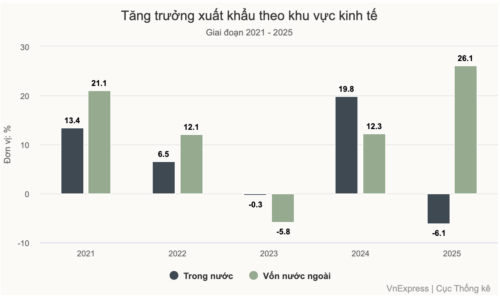
A closer look at the export structure reveals a growing imbalance. Of the USD 475 billion in total exports, shipments by domestic enterprises declined by more than 6% year-on-year and accounted for less than 23% of total export turnover, down from 26.4% in 2021. Meanwhile, FDI enterprises contributed over 77% of exports, equivalent to approximately USD 367 billion, and recorded growth exceeding 26%.
Macroeconomic analysts at Saigon – Hanoi Securities (SHS) described Vietnam’s foreign trade performance as “impressive at first glance,” but warned that most of the gains came from foreign-invested firms. This trend indicates that the relative export capacity of domestic enterprises is weakening.
At a year-end conference in December 2025, Deputy Minister of Industry and Trade Phan Thi Thang acknowledged that Vietnam’s export growth remains insufficiently sustainable due to its heavy reliance on FDI.
Electronics lead growth, traditional sectors under pressure
In terms of product composition, high-tech goods continued to dominate export growth. The General Department of Customs estimated that the three largest export groups computers, phones and components, and machinery and equipment—generated USD 222 billion, accounting for nearly half of total exports and 67% of overall export growth.
At the US market, Vietnam’s largest export destination, strong growth was largely supported by electronics, led by major manufacturers such as Samsung and suppliers within Apple’s value chain. HSBC analysts also noted that “frontloading” accelerating shipments ahead of anticipated tariff changes played a role in boosting exports in 2025. Conversely, traditional industries such as textiles, footwear, and furniture faced increasing pressure. A decade ago, light industrial goods accounted for around 60% of Vietnam’s exports to the US, while technology products represented only 16%. By 2025, this structure had reversed entirely.
Risks extend into 2026
Looking ahead to 2026, export prospects remain uncertain. The frontloading effect is fading, as export turnover in the last three months of 2025 declined by 1.7% compared to the third quarter. The S&P Global PMI survey showed continued growth in new orders, but new export orders fell for the first time in three months. International institutions have warned of weakening global demand. Singapore-based UOB Bank highlighted the risk that reciprocal tariffs could exert downward pressure on global trade, while the OECD cautioned that slowing external demand would weigh on Vietnam’s exports.
Experts agree that Vietnam must shift its export strategy from volume-driven growth to quality-based development. According to SHS, increasing domestic value-added content and technological intensity is essential to reducing dependence on FDI. The government has also urged ministries and overseas trade offices to explore niche markets and develop products that meet specific market demand rather than relying solely on existing comparative advantages. Strengthening linkages between domestic firms and FDI enterprises is seen as crucial to building long-term competitiveness.