

 Tiếng Việt
 中文 (中国)
In 2025, Vietnam’s fruit and vegetable exports recorded strong growth, reaching USD 8.56 billion, up 19.8% compared to 2024. Among export products, durian remained the key driver, generating approximately USD 3.86 billion in export value and accounting for over 45% of the total sector turnover.Notably, fresh coconut exports surpassed dragon fruit for the first time, becoming the second-largest fruit export of Vietnam, with an export value of nearly USD 534 million, representing an increase of almost 37% year-on-year. This milestone reflects a clear shift in Vietnam’s fruit export structure. Meanwhile, dragon fruit ranked third, with export value exceeding USD 525 million, down 1.5% compared to 2024. Other products recorded positive growth, including pistachios with over USD 466 million, up 72.3%; mangoes at USD 409 million, up 10.4%; and bananas at USD 405 million, up 6.6%.
According to the Import-Export Department of the Ministry of Industry and Trade, the signing of the Protocol on fresh coconut exports to China provided a significant boost to coconut exports in 2025, helping expand market access and enhance export value.Despite facing increasing competition, dragon fruit exports have maintained a relatively high share by shifting toward markets such as India and the Middle East. Other fruits, including mango, pomelo, passion fruit, and longan, continued to show stable growth. Notably, passion fruit now accounts for approximately 25% of Vietnam’s fruit and vegetable exports to the European Union, highlighting growing opportunities in high-standard markets.
Currently, China remains Vietnam’s largest fruit and vegetable export market, with export turnover exceeding USD 5.5 billion, supported by additional protocols for frozen durian and fresh coconut, as well as a transition from border trade to official export channels, which has helped stabilize order values. The Import-Export Department noted that the export market structure in 2025 indicates Vietnam is gradually reducing dependence on a single market, while increasingly establishing its presence in countries with high technical standards. In particular, processed fruit and vegetable products now account for over 30% of total export value, contributing to higher added value.
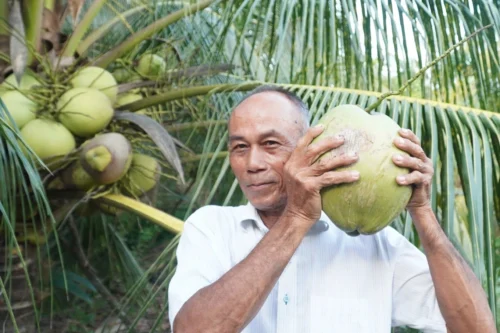
According to the Ministry of Agriculture and Environment, Vietnam currently has approximately 200,000 hectares of coconut plantations, producing around 2 million tons annually. Notably, nearly one-third of the total coconut-growing area meets organic standards recognized by the United States and Europe, mainly concentrated in the Central region and the Mekong Delta. In particular, Ben Tre Province (formerly, now part of Vinh Long Province) has more than 80,000 hectares of coconut plantations, the largest in the country. Coconut farming provides a livelihood for over 70% of the local population, playing a vital role in agricultural development and sustainable exports.