

 Tiếng Việt
 中文 (中国)
Thailand’s Nam Hom coconut industry is facing a severe crisis as Vietnam has taken over one of its most profitable export markets China chooses Vietnamese coconuts.
According to The Nation Thailand (October 23), prices of Thai coconuts have plunged sharply after China chose Vietnamese coconuts as their preferred import source. The situation in Thailand has become so dire that farmers have been forced to slash prices, selling at less than half their production cost. In Songkhla province, farmgate prices for coconuts have dropped to just 2-3 baht per fruit (1,600-2,400 VND), while average production costs remain around 4-5 baht per fruit.
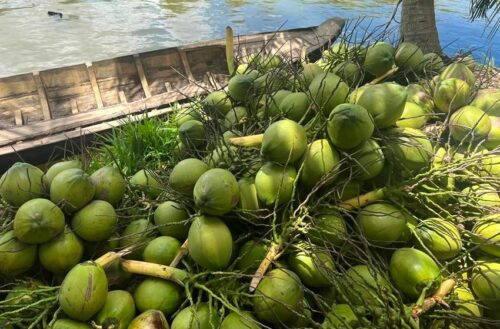
The report highlighted that this steep price decline is largely due to Vietnam’s coconut export strategy. Compared to Thailand, Vietnam enjoys a significant geographical advantage that reduces transportation costs to China one of the main reasons why China chooses Vietnamese coconuts over Thai ones.
Moreover, the Vietnam coconut industry operates on a larger scale, with more consistent quality and better agricultural control systems. In contrast, Thailand continues to struggle with systemic issues such as inconsistent product quality and the absence of a comprehensive cultivation plan. Many Thai farmers accuse their government of “abandoning” them amid fierce market competition. “The Chinese market has extremely high demand and was once Thailand’s largest buyer. Now, this market has swiftly shifted to Vietnam,” said agricultural management expert Tattawin Saruno in an interview with The Nation.
Global demand for coconuts is increasing rapidly, with the market expected to grow from USD 3.5 billion in 2023 to USD 8.2 billion by 2032. According to Vietnam News Agency (TTXVN), Vietnam’s coconut export turnover is forecast to reach USD 1.15 billion in 2025, helping the country maintain its position among the world’s Top 5 coconut exporters. Mr. Cao Bá Đăng Khoa, Secretary General of the Vietnam Coconut Association, said that in just the first half of 2025, exports of the four main coconut product groups reached over USD 520 million, an increase of 20% compared to the same period in 2024.
In some Thai regions, traders have even refused to buy coconuts, leaving farmers unwilling to harvest. With an annual production of around 500 million coconuts, a price drop of just one baht could cause losses of 500 million baht for the Thai industry. The crisis has hit hardest in Ratchaburi and Samut Sakhon, Thailand’s largest coconut-growing provinces. Thailand’s coconut export sector, worth tens of billions of baht annually, now faces serious threats. With efficient integration strategies, logistical advantages, and consistent quality, China chooses Vietnamese coconuts not only demonstrates Vietnam’s growing competitiveness but also marks the nation’s stronger role in the global agricultural supply chain.